Why Seeking Security Outward Is a Dead End
In the first module, we distinguished between anxious, avoidant, and secure attachment styles. But as we move into the second module, we need to confront a more subtle pain point: even if you understand your attachment type, why does your heart rate still spike and your mind race the moment your partner goes silent or seems distant?
This comes down to a physiological loop of “learned helplessness” and “hyperarousal.” When we outsource our sense of security entirely to our partner, every minor shift in their mood becomes a stressor for us. The amygdala in our brain is repeatedly triggered, creating a shortcut: partner doesn’t reply → threat perception → cortisol rises → anxiety behaviors (pursuing, testing, giving the cold shoulder) → partner puts up defenses → threat confirmed → even deeper anxiety. Breaking this cycle can’t rely on just “thinking positively”; it requires an intervention system that integrates physiological regulation with cognitive reframing.
From “Being Held” to “Holding Yourself”
“Being held” is an ideal state in a partnership, but “holding yourself up” is a foundational adult skill. Here, “holding yourself up” doesn’t mean suppressing your emotions; it means building emotional containment. We often say “self-soothing,” but many people misinterpret this as “forcing yourself to calm down.” In fact, true self-soothing operates on three levels:
- Physiological level: Lowering sympathetic nervous system arousal to help your body step out of “fight-or-flight” mode.
- Cognitive level: Identifying and correcting catastrophic thinking, and distinguishing between “facts” and “interpretations.”
- Meaning level: Affirming your independent self-worth, understanding that “even when it hurts right now, I can survive.”
Practical Scenarios: Managing Four High-Frequency Crises
Scenario 1: “Boundaries and Presence” When Your Partner Is Down
This is where it’s easiest to misstep. Your instinct may be to “fix” your partner, but if they actually need space, your closeness will be perceived as an intrusion. This course will teach you how to find that delicate balance between “wanting to help” and “not interfering,” so you can offer support while protecting your own emotional boundaries—not getting swallowed up by their low mood.
Scenario 2: The “Physiological Pause Button” When Anxiety Flares
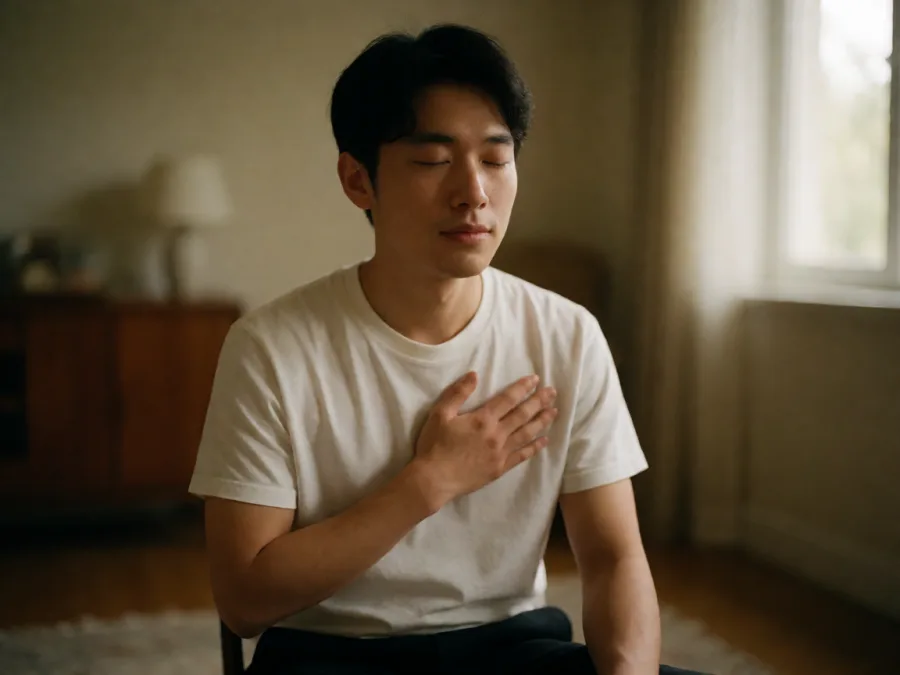
When panic hits, logic doesn’t work. We will provide a set of immediate intervention techniques based on breathing and body awareness, helping you interrupt the neural pathways of emotional hijacking within the 30 seconds before you speak, buying time for rational dialogue.
Scenario 3: Late-Night Rumination and “Thought-Looping”
A lot of anxiety doesn’t happen in the conversation itself; it happens in the late-night spirals of overthinking. We will distinguish between “constructive reflection” and “destructive rumination,” and provide a specific template for an evening emotional review, so your random thoughts can land and stop spinning aimlessly in your head.
Scenario 4: From “Begging for Love” to “Building an Inner Value System”
The key to this advanced stage is de-externalizing your worth. If you still need your partner’s praise to confirm that you are worthy of love, the relationship will always remain fragile. We will practice building a coordinate system of self-worth that doesn’t depend on external feedback, so you can understand: love is not a test to grade me; it is part of my whole life.
The Long-Term View: Accumulating “Learned Security”
Secure attachment isn’t innate; it can be built through “learned security” in later life. This takes time and repeated, small practice. At the end of the course, we will give you a 21-day micro-practice plan, breaking down the skills above into actionable daily steps. Remember: the goal is not to become someone without emotional ups and downs, but to become the captain who can still steer the ship in the middle of an emotional storm. Your partner is a crew member—but you must first be the captain.